Match the port to the appliance
Read the input label, including any power adapter. An appliance suited to the 12 V DC port must also stay within its 10 A and 120 W ratings. For AC equipment, confirm the voltage, frequency, continuous draw and startup demand. A 1,000 W peak rating cannot support a 1,000 W steady load.
| Illustrative scenario | Available energy | Constant 50 W load |
|---|---|---|
| Ideal upper bound | 550 Wh | 11 hours |
| Assuming 85% delivered | 467.5 Wh | 9.35 hours |
Work an example in watt-hours
Assume a constant 50 W load and a fully charged 550 Wh battery. The ideal upper bound is 550 ÷ 50 = 11 hours. With an illustrative 85% delivered-energy fraction, the estimate falls to 9.35 hours. Use a measured fraction for the selected port and operating conditions before quoting a runtime to a customer.
For a fridge, measure a full cycle
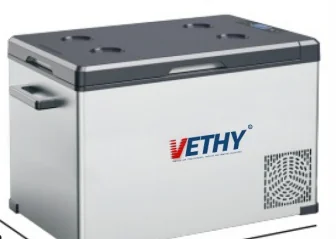
A compressor cycles as load and temperature change. Record the appliance’s measured Wh over a representative day, with the planned setpoint and ambient temperature. Divide measured daily energy by 24 to get average watts. Check startup compatibility independently, because averaging hides a short current peak.
Plan the next charge
Compare the measured daily demand with the energy the station can regain during the available charging window. Ask for the charger input specification and the exact supplied adapter. This is especially important where the local outlet differs from the 220 V / 50 Hz version shown here.