How to Install a Parking AC: Step-by-Step Guide for 2026
Step-by-step 2026 guide to installing a parking AC: roof prep, 14x14 cutout, gasket, wiring (4 AWG, 80A fuse), commissioning. 6–9 hours DIY, $325 in parts beyond the unit.
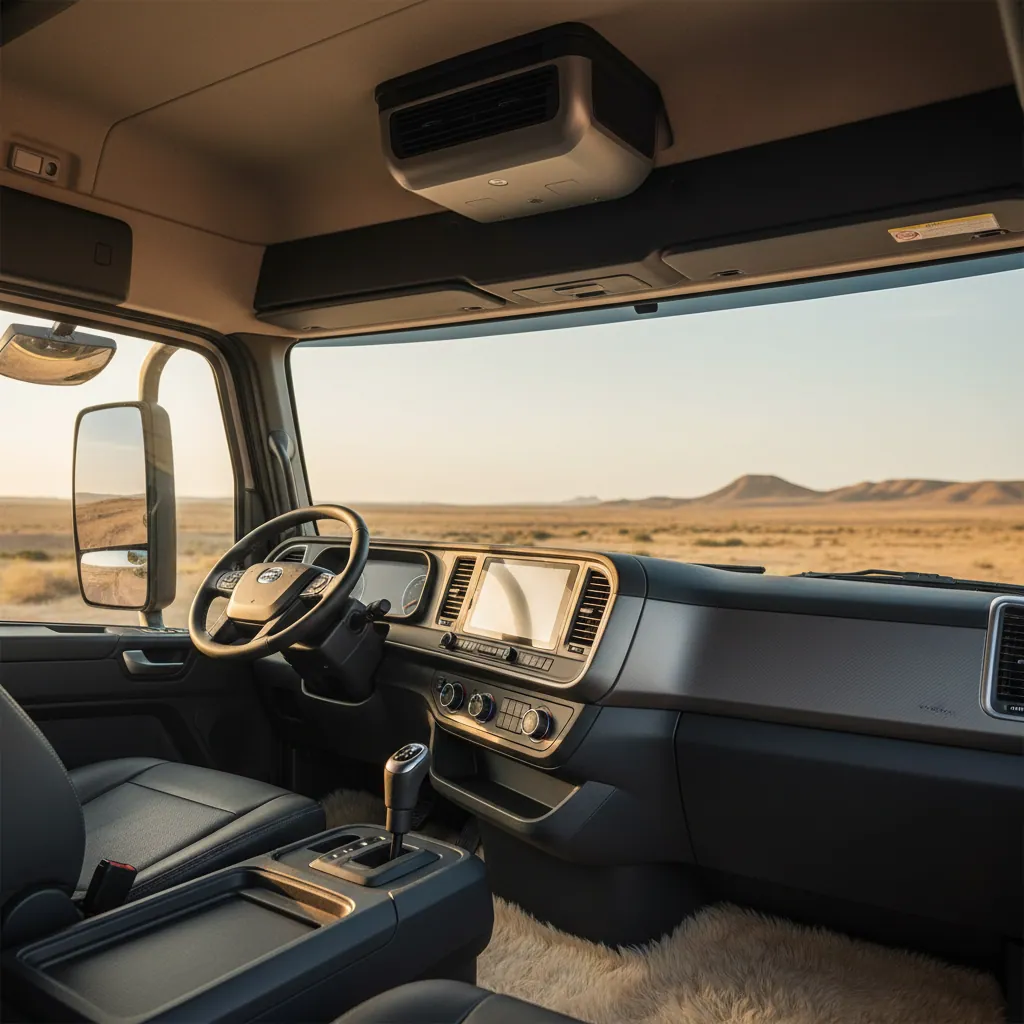
Installing a parking AC yourself saves $480–$1,800 over shop labor and gets you a system you actually understand. The procedure below is what an experienced fleet installer does in roughly 6 hours on a Sprinter, Freightliner Cascadia, Peterbilt 579, or Class B RV — adapt section dimensions and clearances to your specific cab or RV roof. The tools cost about $180 if you buy everything new (most of which you'll keep). The only step where you cannot afford to cut corners is the roof gasket and sealant: a leaky install will rot your headliner inside one rainy season and is the single most expensive failure mode of an otherwise sound system.
Before You Start: Compatibility Check
Confirm five things before you cut metal. Skipping any of these is how 90% of failed installs happen.
1. Roof structure. You need a flat or near-flat (≤3° slope) section with at least 28 × 28 inches of unobstructed real estate, free of internal ribs that would block the cutout. Most modern semi sleepers (Cascadia, T680, 579, Volvo VNL, International LT) have a designated factory cutout location marked from underneath; use it. RV roofs require you to verify rib spacing from inside before measuring outside.
2. Battery bank capacity. A 7,200 BTU 12V DC unit pulls 35–55 A continuously. If your existing house bank is a single Group 31 AGM (100 Ah, ~50 Ah usable), you will get less than 90 minutes of cooling. Plan to install at minimum 200 Ah of LiFePO4 in parallel with — or replacing — the existing bank. See LiFePO4 sizing guide.
3. Alternator output and wiring. Verify your alternator can sustain the AC draw plus normal house loads while driving without overheating. Factory Sprinter, Promaster, Transit, and Class 8 truck alternators (180–250 A) all handle this without modification. Older fleet trucks (pre-2015 W900, T800, etc.) with 130 A alternators may need a second alternator or a smaller AC unit.
4. Roof material. Aluminum (Class 8 truck cab roof, most newer RV) and fiberglass (Class B/C RV) accept the standard 14 × 14 inch aluminum-frame cutout with a butyl gasket. Steel roofs (some box trucks, older school bus skoolies) require a primer coat in the cutout edge to prevent rust at the cut line.
5. Local regulations. Idle reduction rules vary by state — see US anti-idling laws by state. Most fleet trucks are required by current 2026 regulations in CA, NY, NJ, MA, CT, MD, and 22 other states to use a non-idle cooling solution. A parking AC install is universally compliant; check whether your fleet has a preferred-vendor or warranty-required installer policy first.
Tools and Materials Checklist
Tools (one-time purchase, ~$180):
- Jigsaw with 14+ TPI metal-cutting blades (3 spare blades)
- Cordless drill with 3/8 in and 1/2 in bits
- Digital torque wrench (10–80 ft-lb range)
- Tape measure, square, fine-tip marker
- Putty knife, plastic scraper, isopropyl alcohol
- Cable cutters, crimper for 8–4 AWG lugs
- Heat gun, multimeter, clamp ammeter (DC capable)
- Caulk gun, ladder rated 300 lb+
Materials per install (~$325 in parts beyond the AC unit and battery):
- Marine-grade butyl gasket strip (Dicor 501LSW or equivalent), $45
- Self-leveling lap sealant tube (Dicor 501LSW), 2 tubes, $28
- 4 AWG marine-tinned copper cable, 6 ft pair, $65
- Class T fuse, 80 A, with holder, $48
- Anderson SB175 connector pair, $32
- 200 A battery disconnect switch, $55
- Heat shrink tubing assortment, $12
- Stainless self-tapping screws #14 × 1.25 in, qty 16, $8
- 3M VHB tape (4 ft, for cable routing), $14
- Wire loom split, 3/4 in × 8 ft, $9
- Cable glands or grommets for headliner penetration, $9
Most of these are stocked at any commercial truck or marine supply store. Avoid generic auto-parts butyl tape — RV/marine-grade Dicor or Sika products have a 10–12 year UV life vs. 2–3 years for generic. Total project cost (parts only) for a CoolDrivePro VS02 PRO install with new wiring: $1,750 + $325 + battery cost. See best parking AC 2026 for full unit comparison.
Step 1: Plan and Mark the Roof Cutout (45 min)
From inside the cab or RV, locate the planned center of the cutout. For a 14 × 14 in unit, you need 14.25 × 14.25 in clearance with no rib intrusion in any direction. Mark the four corners by drilling a 1/8 in pilot hole through the roof from inside. This guarantees the outside cut aligns with the actual interior clearance.
From outside, lay the AC unit's mounting template on the roof using the four pilot holes as reference. Confirm with a square. Mark the cut line with a fine permanent marker. Then double-check by sliding the actual AC unit onto the marked area — confirm the gasket footprint extends at least 1.25 in beyond the cut line on all sides.
Critical: measure twice, cut once. A misaligned cutout cannot be patched economically — you will have to either move the install location entirely or replace the roof panel ($1,800–$4,500). On Class 8 trucks with stamped-aluminum roof panels, an off-center cut can compromise structural integrity; consult your truck manufacturer's body builder guide if in doubt.
Apply 2 in painter's tape just outside the cut line to protect paint from jigsaw shoe scratches and to give the marker line a clean reference.
Step 2: Cut the Roof Opening (30 min)
Drill a 1/2 in starter hole inside one corner of the marked square — this is where you'll insert the jigsaw blade. Use cutting oil on the bit; aluminum gums up dry bits within 3 holes.
Install a fresh 14 TPI metal-cutting blade in the jigsaw. Set the orbital action to zero (straight reciprocating). Cut slowly — about 4–5 in per minute — letting the blade do the work. Heat is your enemy: if you smell hot metal or see blue discoloration on the blade, stop and let it cool 60 seconds. Plan for two blade changes per install on aluminum, three on steel.
Work the cut clockwise. As you complete the final side, have a helper support the cutout piece from inside so it doesn't drop and damage interior surfaces. The cutout aluminum is worth saving — it makes a perfect template for the next install or for diagnostic gasket testing.
Deburr the cut edge with a flat file. Any rough edges will eventually slice through the butyl gasket. On steel roofs, immediately apply a zinc primer to the bare cut edge to prevent rust migration into the headliner over the next 5 years.
Vacuum all metal shavings from inside the cab — DC fan motors will ingest them via the ventilation circuit and cause premature bearing wear within 90 days.
Step 3: Apply Gasket and Mount the Unit (60 min)
Clean the roof surface around the cutout with isopropyl alcohol. Allow 5 minutes to flash off completely — any residue will prevent the butyl from adhering.
Apply the marine-grade butyl gasket strip in a continuous loop around the cut line, with no gaps and no overlap exceeding 1/4 in. The gasket should sit 3/16–1/4 in proud of the roof surface uncompressed; it will compress to ~1/16 in once the AC unit is torqued down. Press firmly with a roller or the back of a putty knife to eliminate trapped air bubbles.
From outside, lower the AC unit onto the gasket, aligning the unit's bolt holes with the cutout. From inside, position the interior trim ring or distribution box so its bolt holes align with the AC unit's threaded studs.
Thread all four mounting bolts finger-tight, then tighten in a cross pattern (1, 3, 2, 4) in three passes: hand-tight, half torque, full torque. Final torque is unit-specific — CoolDrivePro VS02 PRO calls for 18 ft-lb; Dometic RTX series 22 ft-lb; Webasto Cool Top 25 ft-lb. Do not overtighten — crushed gasket fails just as fast as no gasket.
Apply self-leveling lap sealant in a continuous bead around the perimeter where the AC unit meets the roof, fully covering the gasket edge. Smooth with a wet finger or plastic spreader. The sealant cures in 4–8 hours and is fully water-resistant after 24 hours.
Step 4: Run the Battery Cable (90 min)
The cable run is the most time-consuming step on a finished cab or RV with installed headliner. Plan the path before you cut anything: shortest distance from the AC unit's wiring entry point to the battery bank, avoiding (a) sharp metal edges, (b) heat sources like exhaust manifold or muffler, (c) areas of frequent flexing like door hinges.
Drill a 1 in entry hole through the headliner near the AC unit's wiring connector. Install a marine-grade rubber grommet to protect the cable from chafing. Route the 4 AWG positive and negative cables from the AC unit, through the headliner, down through a B-pillar or sleeper closet, into the battery compartment.
Fuse placement is non-negotiable: the 80 A class T fuse must be installed within 18 inches of the positive battery terminal. Not at the AC unit. Not in the middle of the cable run. At the battery. This is required by NFPA 1192 (RV) and NEC marine wiring practice; it protects the entire cable run from shorting in a crash or chafe failure.
Crimp 4 AWG copper lugs onto both ends of each cable using a hydraulic crimper or a hammer crimper. Solder is acceptable as a secondary measure but never a substitute for proper crimp — solder joints fail at the solder/wire interface under vibration. Seal each crimp with adhesive-lined heat shrink (3:1 ratio).
Install an Anderson SB175 connector at the AC unit end of the cable for serviceability — when the unit eventually needs warranty service, this connector lets you remove the AC in 5 minutes vs. cutting and re-crimping the cable.
Attach negative cable to a chassis ground stud (factory-provided on Sprinter and Class 8 trucks; bolt to a clean, paint-free chassis location on RVs). Verify chassis-to-battery negative continuity with a multimeter — should be ≤0.05 Ω.
Step 5: Install Disconnect, Verify, and First Power-On (45 min)
Install the 200 A battery disconnect switch in the positive cable between the battery terminal and the class-T fuse. Switch should be accessible from outside the battery compartment — code requirement in CA, OR, WA for any battery system over 1 kWh.
Continuity and polarity check before connecting battery:
- With disconnect OFF, multimeter on continuity setting: probe positive cable both ends — should beep.
- Probe negative cable both ends — should beep.
- Probe positive to negative at AC unit — should NOT beep (no short).
- Probe positive to chassis at battery end — should NOT beep (no short to ground).
If all four checks pass, install the class T fuse (insert with disconnect OFF). Connect cables to battery terminals: positive first, then negative. Confirm cable lugs are tight to manufacturer's torque spec (typically 8–12 ft-lb for terminal posts).
Flip the disconnect to ON. The AC unit's display should illuminate within 2 seconds. If not, immediately turn disconnect OFF and recheck cable polarity.
First power-on procedure:
- Confirm thermostat is set to 80°F (above ambient — AC