LiFePO4 Battery for Parking AC: 2026 Sizing & Wiring Guide
2026 LiFePO4 sizing guide for parking AC: 220Ah ($700), 280Ah ($1,750), 400Ah ($2,400) options with 8-hr runtime math, BMS/fuse/cable specs.
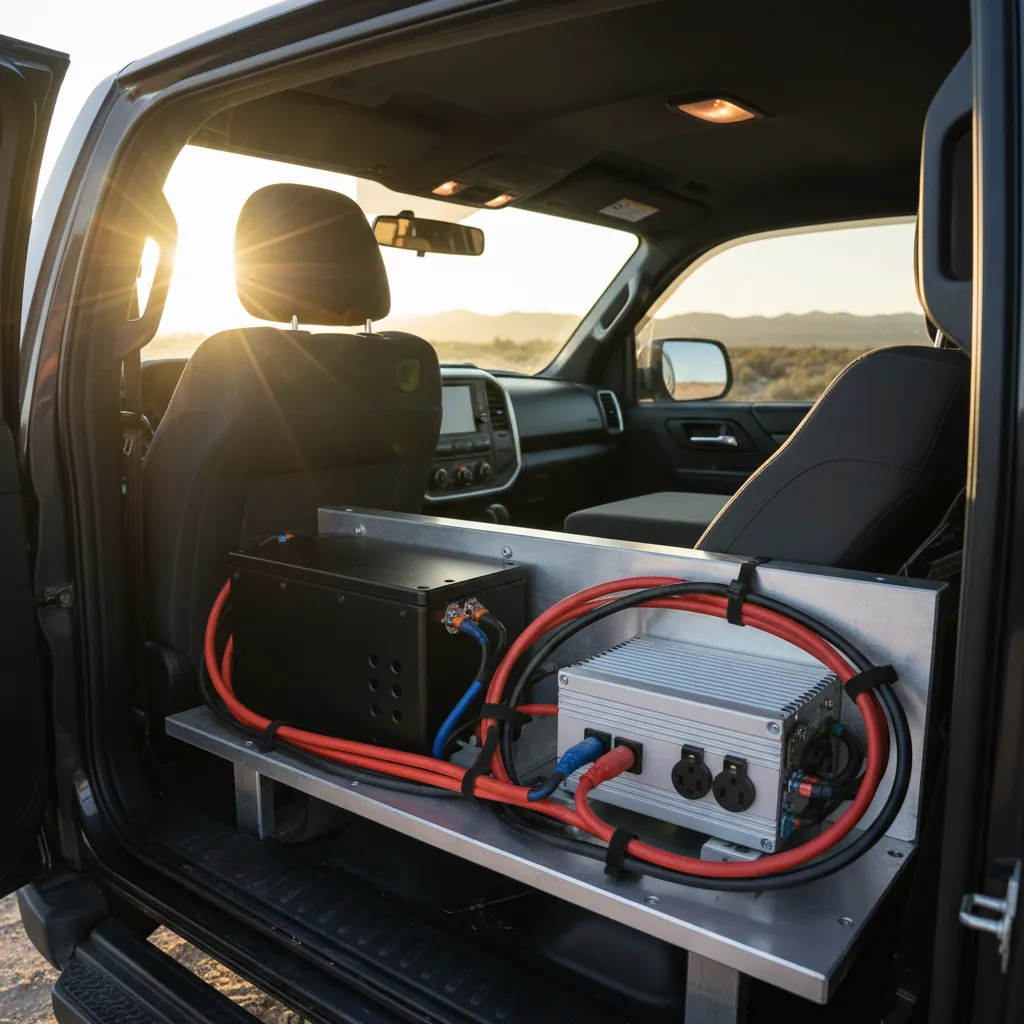
LiFePO4 (lithium iron phosphate) is the only battery chemistry that makes economic and practical sense for a parking AC build in 2026. The price collapsed roughly 40% between 2022 and 2025 as Chinese cell production scaled, and a 220Ah 12V drop-in battery now sells for $700 — the same price as a 100Ah AGM five years ago. This guide covers exact Ah sizing for the three most common parking AC build categories, BMS topology decisions, fuse and cable specs, charging architecture, and the field-tested mistakes that destroy lithium banks before their warranty expires. The math is unforgiving: undersize by 20% and you wake up at 04:00 in a hot cabin; oversize by 50% and you've spent $700–$1,400 you didn't need to spend.
Why LiFePO4 (Not AGM, Not NMC, Not Lead Acid)
Three competing chemistries existed in the truck/RV battery market through 2023; by 2026 the comparison is one-sided.
| Chemistry | Usable Ah per 100 nameplate | Cycles to 80% capacity | Cost per usable kWh (2026) | Weight per usable kWh |
|---|---|---|---|---|
| Flooded lead-acid (FLA) | 50 Ah | 400 cycles | $620 | 71 lb |
| AGM | 50 Ah | 800 cycles | $580 | 64 lb |
| LiFePO4 | 95 Ah | 4,000+ cycles | $310 | 27 lb |
| NMC (Tesla-style) | 90 Ah | 2,500 cycles | $290 | 18 lb |
Lead-acid is dead for parking AC use because the 50% depth-of-discharge limit means you must buy 2× the nameplate Ah you actually need, doubling weight and cost per usable kWh. AGM is marginally better but still uneconomical when LiFePO4 cycles 5× longer for half the per-kWh cost.
NMC (the chemistry in Tesla and most EV battery modules) has the highest energy density but two practical problems for RV/truck use: (1) thermal runaway risk above 150°F, which happens in any uninsulated battery compartment in summer, and (2) NFPA 1192 (RV) and NFPA 70 (NEC) both require additional fire suppression for NMC banks above 5 kWh — adding $400–$900 to the install. LiFePO4 is fundamentally non-flammable (cells fail by venting smoke, not igniting), passes all the same tests without suppression, and has 95% the cycle life at 60% the cost.
For the rest of this guide assume LiFePO4. Specifically, the recommended manufacturer list as of 2026 is: Battle Born, EG4, Lion Energy, Renogy, EcoFlow, and Will Prowse–vetted Chinese imports (Ampere Time, LiTime, Power Queen) for budget-conscious builds. All offer 10-year prorated warranties and ship with integrated BMS. Avoid no-name AliExpress packs without BMS — the cells are usually fine but no-BMS installs fail UL 1973 certification and may void your RV insurance.
Sizing Math: How Many Amp-Hours Do You Need?
The formula is: Required Ah = (AC watts × hours) ÷ (system voltage × 0.95 LiFePO4 efficiency).
For a 12V system: required Ah = (W × h) ÷ 11.4. For a 24V system: (W × h) ÷ 22.8.
Worked examples for the three most common build categories:
Category 1: Class B van or sleeper truck cab, 7,200 BTU AC, mild summer (75–82°F overnight low): - AC average draw: ~330 W (low duty cycle, well-insulated cabin) - Target runtime: 8 hours - Required: (330 × 8) ÷ 11.4 = 232 Ah at 12V - Recommended: 280 Ah at 12V (gives 22% headroom for hot nights and battery aging). Cost: ~$1,750.
Category 2: Class C RV or extended sleeper, 9,500 BTU AC, hot summer (85–92°F overnight low): - AC average draw: ~520 W - Target runtime: 8 hours - Required: (520 × 8) ÷ 11.4 = 365 Ah at 12V (or 183 Ah at 24V) - Recommended: 400 Ah at 12V or 200 Ah at 24V. Cost: ~$2,400 / ~$2,250.
Category 3: Class A motorhome or skoolie, 13,500 BTU AC (single zone), hot summer: - AC average draw: ~720 W - Target runtime: 8 hours - Required: (720 × 8) ÷ 22.8 = 253 Ah at 24V (or 506 Ah at 12V) - Recommended: 280 Ah at 24V (12V version impractical due to cable size). Cost: ~$3,400.
Adjusters (multiply baseline Ah by these factors):
- Add 15% if you also run a 12V fridge, lights, fans, water pump from the same bank.
- Add 10% if you live in a hot climate where overnight low stays above 80°F.
- Add 8% per year of expected battery age (LiFePO4 loses ~0.8% capacity per year of age plus ~0.04% per cycle).
- Subtract- 10% if your AC unit is variable-speed inverter type (CoolDrivePro VS02 PRO, VX3000SP, Dometic RTX) — these run at lower duty cycles than fixed-speed compressors.
For very precise sizing (within ±5%), the parking AC fuel savings calculator includes a battery sizing tab that takes your actual climate data and AC model and produces a recommended Ah with confidence interval.
12V vs 24V: Pick Before You Buy Batteries
Voltage architecture is a one-time decision that affects every other component spec. Once you have batteries, switching is expensive (effectively a full rebuild).
Choose 12V if:
- Total bank capacity is under 4,800 Wh (under 400 Ah at 12V).
- Your existing house DC system is 12V (most Class B vans, all sleeper truck cabs).
- You want maximum compatibility with off-the-shelf RV accessories (fridge, lights, fans).
- Cable runs from battery to AC are under 8 feet.
Choose 24V if:
- Total bank capacity exceeds 4,800 Wh.
- Your AC unit is 24V-only (Dometic RTX, Webasto Cool Top, RigMaster).
- Cable runs exceed 10 feet (24V allows half-size cable for the same power).
- You're integrating with a 240V split-phase inverter for residential appliances.
Why this matters financially: A 4,800 Wh bank at 12V requires 2/0 AWG cable and a 250A class-T fuse — roughly $185 in just power infrastructure. The same bank at 24V uses 4 AWG cable and a 125A fuse — roughly $85. The 24V architecture saves $100 in cabling per build and runs cooler under load. The downside is that you need a DC-DC converter ($120–$280) to power 12V house loads.
For 48V architectures (rare but emerging in 2026 for skoolies and large Class A): even better cable economics, but you need a 48V→12V converter and 48V-compatible solar charge controller. Ecosystem support is improving (EcoFlow, EG4, Victron all ship 48V hardware) but plan to spend extra time sourcing components.
Deeper comparison: see 12V vs 24V parking AC for the full architecture decision tree.
Series vs Parallel: Wiring Multiple Batteries
Most builds use 2–4 LiFePO4 batteries wired in parallel (or series for 24V architecture). The wiring topology affects performance significantly.
Parallel wiring (12V example with two 200 Ah batteries → 12V, 400 Ah total):
Connect all positive terminals together with a busbar; connect all negative terminals together with a separate busbar. Use equal-length cable from each battery to the busbar — unequal cable lengths cause one battery to discharge faster than the other, which over time imbalances the bank.
Series wiring (24V example with two 12V batteries → 24V, original Ah unchanged):
Connect positive of battery 1 to negative of battery 2. The remaining negative (battery 1) and positive (battery 2) become the bank's terminals. Critical: all batteries in a series string must be from the same manufacturer, same model, same age, and at matched SOC at the moment of connection. Mismatched series cells fail prematurely as the BMS in each battery fights to balance against the others.
Series-parallel (both 24V and high Ah, e.g., 4× 12V 200Ah → 24V 400 Ah):
Wire two pairs in series first, then parallel the two strings. Same matching requirements as series. Best practice: buy all batteries on the same order from the same vendor to maximize cell-batch consistency.
Mistake to avoid: mixing battery brands or chemistries in the same bank. Even between two LiFePO4 brands, internal resistance, BMS thresholds, and age curves differ — the older or higher-resistance battery becomes a parasitic load on the newer one and both degrade faster.
For parallel banks of 3+ batteries, use a busbar (Blue Sea Systems 600A or equivalent) rather than daisy-chaining battery to battery. Daisy chains create unequal current paths; busbars equalize current draw across all batteries.
BMS Selection and Capacity
Every modern LiFePO4 battery ships with an integrated BMS. The question for a parking AC build is whether the BMS continuous current rating exceeds your AC's peak draw.
Match BMS to AC peak current with at least 50% headroom. Examples:
- 7,200 BTU AC drawing 38A peak → 60A BMS minimum (most 200Ah+ LiFePO4 ship with 100A BMS, more than adequate).
- 9,500 BTU AC drawing 55A peak → 100A BMS minimum.
- 13,500 BTU AC drawing 75A peak → 120A BMS minimum (some 280Ah+ batteries ship with 150–200A BMS for this use case).
Battery makers list the BMS continuous current rating in the product specs; e.g., Battle Born GC2 100Ah ships with a 100A BMS, EG4 LiFePower 280Ah ships with a 200A BMS. Pick a battery whose BMS spec exceeds your AC peak by 50%.
For parallel banks, the effective BMS rating is the sum across batteries (two 100A BMS in parallel = 200A continuous capability). Series banks do not add BMS rating — a series string of two 100A BMS batteries is still limited to 100A continuous because current flows through both BMS units in sequence.
External BMS option: for very large banks (above 600 Ah at 12V or above 300 Ah at 24V), some builders use an external master BMS (Daly, Overkill, JK BMS) instead of relying on individual battery BMS units. This provides centralized monitoring, balancing, and protection across the entire bank. External BMS adds $180–$420 to the build but pays back in warranty avoidance and visibility for very large installs.
Verify BMS communication protocol matches your inverter and solar charge controller (Victron VE.Bus, Mate3, CAN bus, RS485). Mismatched protocols mean the BMS can't tell the charging hardware to throttle when cells are full — leading to over-voltage cutoffs and AC unit interruptions. The major brands (Victron, Renogy, EG4) have ecosystem-matched components specifically to avoid this.
Cable, Fuse, and Disconnect Specs
Underspec'd power infrastructure is the second-most-common cause of LiFePO4 bank failure (behind cell imbalance). The basic rule: cable and fuse should handle 1.5× the AC's peak current draw indefinitely, not just for short bursts.
Cable size by AC draw and run length:
| AC peak draw | Run length (one-way) | 12V cable | 24V cable |
|---|---|---|---|
| 38A (7,200 BTU 12V) | up to 6 ft | 4 AWG | 8 AWG |
| 38A | 6–10 ft | 2 AWG | 6 AWG |
| 55A (9,500 BTU 12V) | up to 6 ft | 2 AWG | 6 AWG |
| 55A | 6–10 ft | 1/0 AWG | 4 AWG |
| 75A (13,500 BTU 12V or 24V) | up to 6 ft | 1/0 AWG | 4 AWG |
| 75A | 6–10 ft | 2/0 AWG | 2 AWG |
Use marine-tinned copper (not aluminum, not non-tinned copper). Tinned copper resists corrosion in the high-humidity environment under most RV and truck cabs.
Fuse selection: Class T fuse rated 1.5× the AC peak draw, located within 18 inches of the positive battery terminal. Class T i