Parking AC vs APU: 2026 Cost & Performance Comparison for Fleets
2026 fleet decision guide: parking AC vs APU. 5-year TCO with $4.05 diesel — DC parking AC saves $9,800–$14,200/truck vs diesel APU, $3,200–$5,400 vs idling. 74% lower TCO than APU.
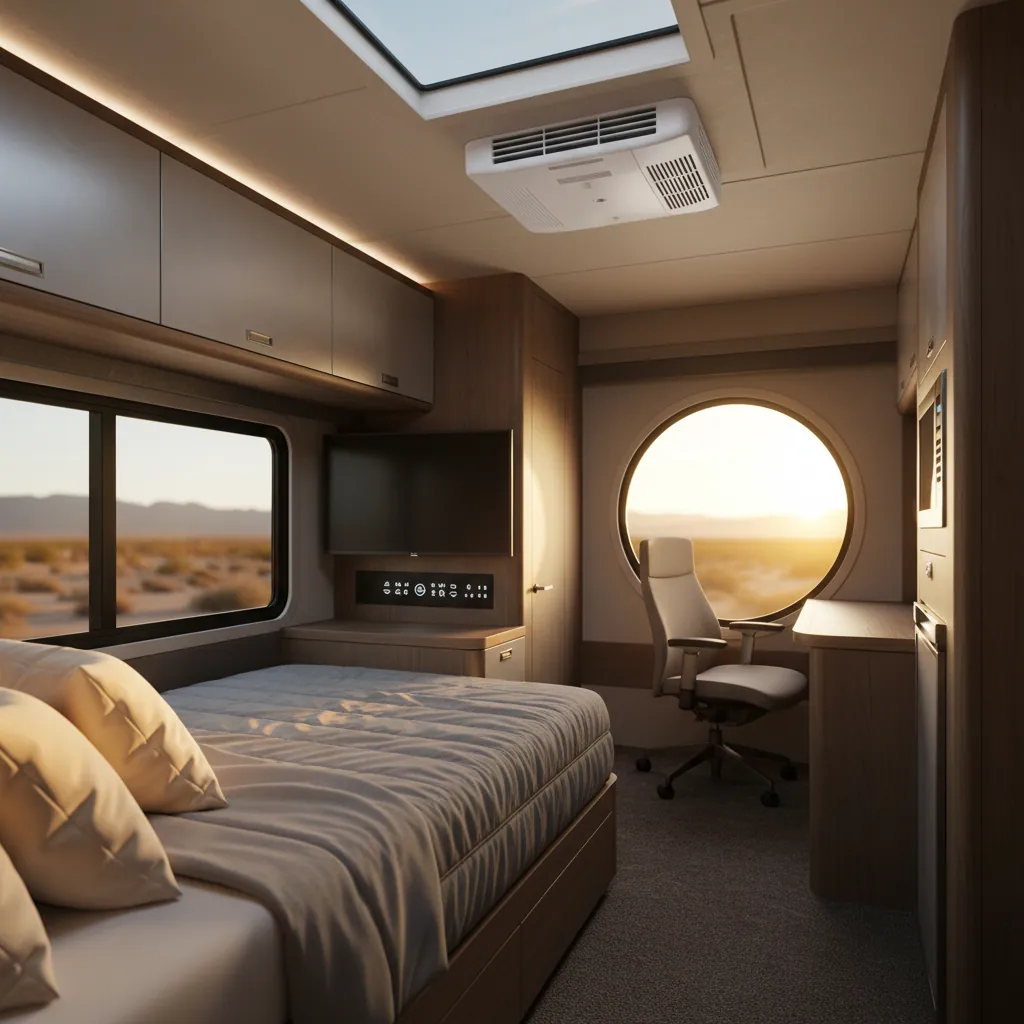
For a fleet manager in 2026, the question is no longer "should we install non-idle cooling." Federal idle-reduction grants, 28 state idle-reduction laws, and $4.05/gal diesel have already settled that question — every long-haul truck spending more than 100 hours per year parked needs a non-idle solution. The remaining question is which solution: battery-powered DC parking AC, diesel APU, or shore-power-only. This guide compares all three against 2026 fuel prices, current EPA SmartWay reimbursement rates, real maintenance costs from Class 8 fleet operators, and 5-year total cost of ownership math. The short answer for most fleets is DC parking AC; the longer answer covers when an APU still makes economic sense and when a hybrid solution wins.
What Each Technology Actually Does
Diesel APU (auxiliary power unit): a small ~25 hp diesel engine mounted on the frame rail behind the cab, with its own AC compressor and 120V generator. Provides cabin cooling, heating, and 120V power without idling the main truck engine. Fuel consumption: 0.18–0.30 gal/hr. Capital cost installed: $9,500–$13,800. Major brands: RigMaster, Carrier ComfortPro, Thermo King TriPac, Tridako Quasar. Designed life: 12,000–18,000 operating hours.
Battery-powered DC parking AC: a rooftop or split-system 12V/24V DC compressor unit fed from a LiFePO4 battery bank, charged by alternator while driving and optionally by solar. Fuel consumption: zero direct. Capital cost installed: $3,800–$6,500 (AC + battery + cable + install labor). Major brands: CoolDrivePro VS02 PRO and VX3000SP, Dometic RTX, Webasto Cool Top, Indel B Sleeping Well. Designed life: 8–12 years on the AC unit, 10–12 years on LiFePO4.
Shore power only: truck plugs into a 30A or 50A receptacle at truck stops, terminals, or yards. Provides AC and 120V from grid. Cost per hour: $0–$3.50 depending on facility. Capital cost: $200–$600 for the inlet and ATS. Limitation: only works where shore power exists.
Hybrid (APU + DC parking AC): install both. Use DC parking AC for normal nightly cooling; use APU only when battery state-of-charge drops or when 120V power is needed for refrigerator, microwave, or block heater. Capital cost: $13,300–$20,300. Designed for fleets running heavy electrical accessories or operating in extreme climates where battery-only doesn't have enough capacity.
For what each technology costs to operate, jump to the TCO section below.
Idle Time vs APU Time vs Battery-AC Time
Before comparing technologies, establish a realistic idle-replacement baseline for your specific fleet operation. Long-haul Class 8 trucks idle 1,800–2,400 hours per year on average (American Transportation Research Institute, 2026). Regional and dedicated fleets idle 600–1,200 hours per year. The non-idle solution only saves money proportional to hours displaced.
Typical operating hour profiles in 2026:
| Fleet type | Annual idle hours | Best-fit non-idle solution |
|---|---|---|
| Long-haul OTR (550+ mi/day) | 2,000–2,400 | DC parking AC + occasional APU |
| Regional (300–550 mi/day) | 800–1,400 | DC parking AC |
| Dedicated/local (sub-300 mi/day) | 200–600 | DC parking AC or shore power only |
| Reefer with PTO | 2,200–2,800 | APU (provides PTO power for reefer) |
| Yard tractor / spotter | 1,500–2,200 | APU or genset hybrid |
| Heavy haul / oversize | 1,200–1,800 | DC parking AC |
The critical factor for choosing between DC parking AC and APU is whether the truck needs 120V AC power overnight (microwave, residential refrigerator, block heater in winter, residential coffee maker). DC parking AC alone provides only 12V/24V loads — perfect for 12V fridge, LED lights, fans, USB charging. If drivers expect 120V appliances, you either need an inverter (added $400–$1,200) or an APU.
For 2026, ATA driver retention surveys show 12V and USB are sufficient for ~75% of long-haul drivers; the remaining 25% specifically request 120V capability for residential appliances. Plan your fleet spec accordingly.
Fuel and Operating Cost Math
Calculations use $4.05/gal diesel (national average week of April 14–20, 2026 from EIA), 1,400 idle hours per year (mid-range OTR profile), and shop labor at $145/hr.
Engine idling baseline (no non-idle solution):
- Fuel: 0.85 gal/hr × 1,400 hr = 1,190 gal/yr × $4.05 = $4,820 fuel/yr
- Engine wear: $0.18/hr × 1,400 = $252/yr added maintenance
- DEF consumption: 0.025 gal/hr × 1,400 × $3.20/gal = $112/yr
- Idle-related fines (avg across CA, NY, NJ, MA): $340/yr expected
- Total: $5,524/yr per truck
Diesel APU operation:
- Fuel: 0.24 gal/hr × 1,400 hr = 336 gal/yr × $4.05 = $1,361 fuel/yr
- APU maintenance (oil, filters, belts): $420/yr
- Major service (every 3,000 hr): $580/yr amortized
- DEF (small APU engines without DEF): $0/yr
- Total: $2,361/yr per truck
DC parking AC operation:
- Fuel: zero direct. Alternator load while driving adds ~0.04 gal/hr to fuel burn = $185/yr added fuel for 1,400 hr equivalent recharge.
- Battery degradation: 1× LiFePO4 bank replacement at year 10–12, amortized = $245/yr
- AC unit service (annual cleaning, no major repairs in first 5 yr): $60/yr
- Total: $490/yr per truck
Shore power only:
- 1,400 hr × avg $1.20/hr facility fee = $1,680/yr
- No fuel or maintenance cost on the truck
- Limitation: not always available; ~30% of overnight stops at typical truck stops have no available shore power
- Total: $1,680/yr per truck (when shore power is accessible)
The per-truck operational savings of DC parking AC vs idling is $5,034/yr; vs APU is $1,871/yr; vs shore-power-only is $1,190/yr. Multiply by your fleet size for total fleet impact. For a 50-truck fleet, switching from idling to DC parking AC saves roughly $251,700/year in operating costs alone. To run your own numbers see the parking AC fuel savings calculator.
5-Year Total Cost of Ownership
Capital cost matters less than operating cost over time. The 5-year TCO comparison includes capex amortized over 5 years plus 5 years of operating cost.
| Solution | Capex installed | 5-yr opex | 5-yr TCO | Annualized cost |
|---|---|---|---|---|
| Engine idling only | $0 | $27,620 | $27,620 | $5,524/yr |
| Diesel APU (RigMaster) | $11,500 | $11,805 | $23,305 | $4,661/yr |
| Diesel APU (Carrier ComfortPro) | $13,200 | $11,805 | $25,005 | $5,001/yr |
| DC parking AC (CoolDrivePro VS02) | $4,200 | $2,450 | $6,650 | $1,330/yr |
| DC parking AC (Webasto Cool Top) | $5,800 | $2,450 | $8,250 | $1,650/yr |
| Shore power only | $400 | $8,400 | $8,800 | $1,760/yr |
| Hybrid (DC AC + APU) | $15,700 | $6,200 | $21,900 | $4,380/yr |
The DC parking AC TCO is 74% lower than diesel APU and 76% lower than continued idling over a 5-year ownership window. The break-even point against APU is reached in roughly 8–14 months.
Fleet financing matters: if you finance the capex over 60 months at 8% APR, monthly cost per truck is $85 for DC parking AC vs $233 for diesel APU. The DC parking AC payment is comfortably absorbed by the operating savings starting from month 1; the APU payment is cash-flow positive but takes ~14 months to fully cover.
For fleets with EPA SmartWay reimbursement eligibility (still active as of fiscal year 2026 with up to $3,500 per truck), the DC parking AC capex effectively drops to $700–$2,300 per truck — pushing payback to under 6 months.
Driver Acceptance and Operational Considerations
TCO math doesn't capture the soft factors that determine whether your fleet's drivers will actually use the system. Five-year operating data from ATA member fleets shows DC parking AC consistently scores higher than APU on driver satisfaction surveys for three reasons:
1. Noise. A modern variable-speed DC compressor produces 44–52 dB at 3 ft (about the level of a quiet refrigerator). A diesel APU produces 68–75 dB at 3 ft (about the level of a vacuum cleaner) — and the noise persists through the entire sleeping hours. Driver retention surveys show 38% of drivers cite APU noise as a sleep-disrupting factor.
2. Vibration. APUs vibrate at the engine's idle frequency, transmitted through the frame rail to the cab. Drivers report this as "shaking the bed." DC parking AC has zero vibration beyond the small fan noise.
3. Smell. Diesel APU exhaust enters the cab through air intakes and HVAC pathways, particularly in light wind conditions. DC parking AC has no exhaust.
The operational considerations differ:
APU advantages:
- Provides 120V AC power for residential appliances out of the box.
- Provides cabin heat in winter without battery drain.
- No dependence on battery state-of-charge — runs as long as fuel is in the tank.
- Longer continuous runtime ceiling (effectively unlimited).
DC parking AC advantages:
- Lower fuel and maintenance cost (above).
- Quieter and vibration-free operation.
- No exhaust regulations (no NOx, no particulate, no DEF requirements).
- Compliant with all 28 state idle-reduction laws including CARB Tier 4 rules in California.
- Easier installation (rooftop unit, no frame-rail real estate required, no fuel line tap).
- No additional engine to maintain.
Most large fleets (250+ trucks) that have done side-by-side trials report a 3:1 driver preference for DC parking AC over APU when both are available on identical truck specs. This is a significant retention tool in the current driver-shortage market.
When an APU Still Wins
Despite the TCO disadvantage, three scenarios still favor diesel APU over DC parking AC in 2026.
Scenario 1: Reefer truck operations. Refrigerated trailer units running on the trailer's own diesel APU benefit from sharing fuel infrastructure and service intervals with a tractor APU. The shared maintenance costs make APU economics tighter than the per-tractor numbers above. Some fleets find the operational simplicity of "one APU vendor for tractor and trailer" outweighs the per-unit savings of DC parking AC on the tractor side.
Scenario 2: Northern climates with extended winter idling. In Minnesota, North Dakota, Montana, Wyoming, Maine, upstate NY winters, drivers may need 12+ hours of sustained cabin heat at -10°F to -25°F outdoor temperature. A DC parking AC unit's heat pump function works down to ~10°F outdoor; below that, it requires resistance heating that drains the battery in 4–6 hours. APUs provide diesel-fired heat indefinitely with no battery limitation. For trucks spending winter in these climates, a hybrid (DC parking AC for cooling + a small diesel night heater like Webasto Air Top 2000 for winter heat) outperforms either solution alone.
Scenario 3: Heavy 120V appliance load. Drivers running residential refrigerators, microwaves, electric kettles, full-size CPAP machines, gaming systems, and entertainment systems consistently draw 1,500–2,500W overnight. A DC parking AC system would require a 3,000W inverter and 800Ah LiFePO4 battery bank to support this load — adding $4,200–$6,800 to the capital cost. At that point, the APU's built-in generator becomes cost-competitive.