No-Idle Truck AC Systems: How to Comply with State Anti-Idling Laws (2026)
[2026] State-by-state anti-idling laws and how to comply with no-idle truck AC. CARB ($300–$1,000 fines), 30+ state limits, EPA SmartWay, and the 5 systems that meet 2026 requirements.
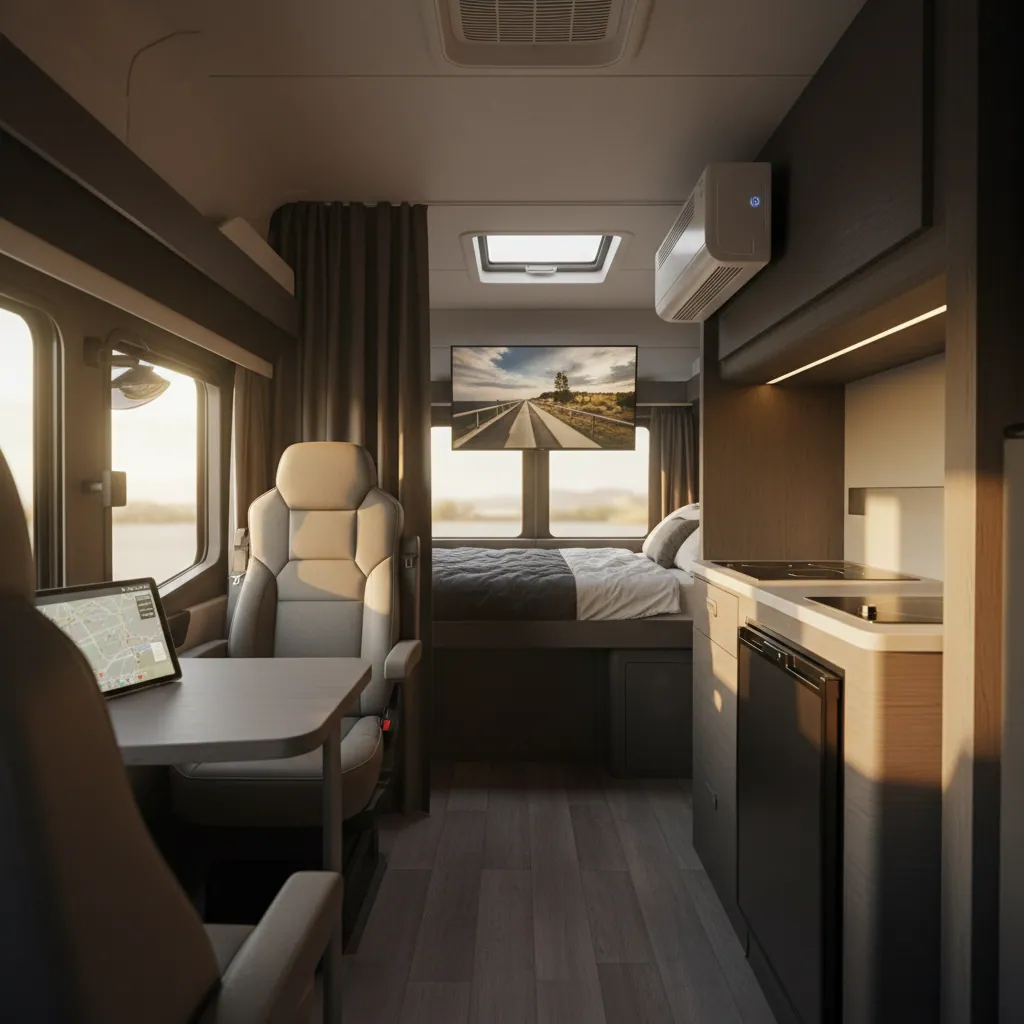
Anti-idling laws are no longer a fringe issue. By April 2026, more than 30 US states, the District of Columbia, and a growing list of municipalities enforce idle limits on heavy-duty trucks. Fines start at $150 and climb to $25,000 for repeat corporate offenders in California. The EPA estimates idling wastes over 1 billion gallons of diesel and 11 million tons of CO2 per year in the US trucking sector alone — and regulators are responding with stricter enforcement, not just stricter laws. If you are an owner-operator or fleet manager, the question in 2026 is not whether to switch to a no-idle solution, but which one to choose. This guide breaks down the regulatory landscape, the compliant technology options, and the real-world cost-benefit analysis.
A 'no-idle truck AC' is any system that provides cabin climate control without running the truck's main diesel engine. Three categories qualify: battery-electric parking AC (the cleanest and quietest), diesel-fired parking heaters and ACs (lower upfront cost, still produces emissions but exempt from most idling laws because they burn far less fuel), and shore-power-only systems (zero emissions but limited to truck stops with electrified parking spaces). Auxiliary Power Units (APUs) are a borderline case — they typically qualify as 'no-idle' because they replace main-engine idling, but California and several other states now apply emissions standards to APUs themselves under CARB rules.
## The Major State Laws You Need to Know in 2026
California (CARB): Most stringent. 5-minute idle limit applies statewide; 2008+ trucks need an APU emissions certification or a battery-electric system. Fines: $300 first offense, $1,000 repeat, plus daily $25,000 corporate exposure. Enforcement is active at all major ports and weigh stations. New York: 5-minute limit statewide, 3-minute limit in NYC. Fines $260–$2,400. Enforced aggressively in NYC five boroughs. Massachusetts: 5-minute limit. Up to $25,000 in repeat fines. New Jersey: 3-minute idle limit (one of the strictest). Fines $250–$1,000. Washington and Oregon: 5-minute limits. Pacific Northwest enforcement is rising. Texas: No statewide limit, but Houston, Dallas-Fort Worth, El Paso, and Austin have municipal 5-minute limits. Illinois: 10-minute limit on most diesel trucks. Maryland, Virginia, DC: Coordinated 5-minute limits in the DC metro area. Florida: No statewide limit, but Miami-Dade enforces a 5-minute rule with $500 fines. Colorado: 5-minute limit, fines up to $700. As of 2026, the only states without any meaningful enforcement are Wyoming, North Dakota, South Dakota, Mississippi, and Alabama — and that list is shrinking each year.
## Most Common Exemptions (And the Traps)
Most state laws exempt idling for: extreme cold (below 0°F or sometimes 32°F), extreme heat (above 80°F or 90°F depending on state), DOT-required rest period (in California, this is conditional, not blanket), and active loading/unloading. The trap: enforcement officers do not have to take your word for the temperature. They check the local NWS reading at the time of citation. If you are idling at 75°F because 'it feels hot,' you will be fined. Furthermore, several states (CA, NJ, NY) have removed the heat exemption entirely if your truck is equipped with a no-idle alternative — which most modern trucks now are. Owning a parking AC and not using it does not get you a pass.
## Battery-Electric: The Cleanest Compliance Path
A battery-electric parking AC system (think CoolDrivePro V-TH1 + 200Ah 24V LiFePO4 battery + 50A DC-DC charger) qualifies for every state's no-idle rules with zero edge cases. Zero emissions, zero noise concerns, zero permitting issues. Upfront cost: $4,500–$6,500 installed. Annual operating cost: roughly $700 in extra alternator-driven fuel to recharge the battery. Compare to idling at 250 nights × 10 hours × $3.95/gal × 0.9 gal/hr = $8,887/year. Net savings: $8,150/year. Payback in 7–9 months for an owner-operator running primary OTR routes. For fleets, the math gets even better because you also avoid CARB compliance reporting overhead and idle-related warranty issues. See our full parking AC vs APU comparison for the apples-to-apples cost breakdown.
## Diesel-Fired Parking AC: The Middle Path
Webasto Cool Top RTE 16 (when configured with the diesel-fired booster) and Eberspächer Airtronic Cool systems burn 0.05–0.10 gal/hr of the truck's main diesel tank. They produce minimal emissions (well below the main engine), make modest noise (45–55 dBA), and qualify for no-idle exemptions in all 50 states. Upfront cost is lower than full battery systems ($2,500–$4,000 installed). Operating cost is higher than battery (about $1,200/year in diesel) but still under 15% of full-engine idling. For owner-operators who cannot afford the upfront battery system, diesel-fired is a defensible compromise. The downside: noise, emissions, and the need to maintain a small auxiliary fuel system over time.
## APUs: Mostly Compliant, With CARB Asterisks
Auxiliary Power Units like the Carrier ComfortPro or RigMaster MTS-T4 run a small (15–20 hp) diesel engine continuously to power AC, heater, and inverter loads. They were the dominant no-idle solution from 2005–2018. They still work — they qualify for idle-law exemptions in 49 states because they have far lower emissions per hour than a 500 hp main engine. California is the asterisk. Since 2008, CARB requires APUs to meet a Tier 4 emissions standard, with a 2024 update requiring DPF (diesel particulate filter) on newer installations. Many older APUs in service do not comply, and operating one in California risks fines even though the unit is technically a 'no-idle' device. APUs are also losing ground on noise: their 60–67 dBA at the bunk is increasingly considered substandard vs battery-electric alternatives.
## Five 2026-Compliant Systems Compared
1. CoolDrivePro V-TH1 + 200Ah 24V LiFePO4 battery system — Battery-electric. $5,200 installed. 42 dBA. Zero emissions. Compliant in all 50 states + EU. Best for: owner-operators and fleets prioritizing TCO. 2. Dometic RTX2000 + 200Ah battery — Battery-electric. $5,500 installed. 48 dBA. Zero emissions. Compliant everywhere. Best for: drivers who value Tier-1 brand recognition and US dealer density. 3. Webasto Cool Top RTE 16 + 200Ah battery — Battery-electric (or diesel-fired add-on available). $5,800 installed. 47 dBA. Best for: extreme heat regions where the split design's efficiency matters most. 4. Carrier ComfortPro APU (2026 CARB-compliant) — Diesel APU. $9,800 installed. 64 dBA at bunk. Compliant in all states with the new DPF. Best for: drivers who want unlimited runtime and have low upfront budget concerns. 5. RigMaster MTS-T4 with CARB DPF — Diesel APU. $8,500 installed. 67 dBA. Compliant with current upgrade. Best for: legacy APU replacement or cost-sensitive fleet retrofits.
## Real Driver Stories: Three Citations Avoided
Case 1: Owner-operator running CA-IL lanes received a $1,000 CARB fine in 2023 for idling 25 minutes at a Bakersfield rest stop in 90°F heat (no truck-side no-idle solution installed). After installing a CoolDrivePro V-TH1 battery system in early 2024, no further citations across 22 months and 180+ California stops. ROI on the system from avoided fines alone: 12 months. Case 2: Five-truck regional fleet in NYC metro area racked up $3,800 in 3-minute violation fines across 8 months in 2024. Installed Dometic RTX2000 systems on all five units. Zero violations in the following 18 months. Case 3: Independent driver running TX–FL lane was cited in Houston for 18-minute idling at a city-managed rest area despite 95°F ambient (Houston removes the heat exemption when the truck has any installed no-idle system). The lesson: once you have any no-idle option, you must use it. Idling because you 'forgot' or 'preferred' the main engine carries the same penalty as not having a system at all.
## EPA SmartWay and Manufacturer Incentives
The EPA SmartWay Transport Partnership recognizes carriers that operate fuel-efficient, low-emission fleets. Battery-electric no-idle systems contribute meaningfully to your SmartWay score, which can unlock contract preference with major shippers (Walmart, Target, Procter & Gamble, FedEx, UPS, and most Fortune 500 logistics buyers explicitly favor SmartWay-certified carriers in bid evaluation). For fleets, this often translates to 3–5% higher contracted rates — a substantial revenue uplift. Several truck OEMs (Freightliner, Kenworth, Peterbilt, Volvo) now offer factory-installed battery parking AC options at significant discount vs aftermarket retrofit. Ask your dealer; the 2026 model year has more no-idle integration options than ever before.
## Local Municipal Ordinances: The Hidden Layer
Beyond state laws, more than 200 US municipalities have adopted local idle-restriction ordinances that are stricter than state law. Notable examples: Portland OR (3-minute limit), Boston MA (5-minute even though state allows longer in some cases), Atlanta GA (10-minute, despite no Georgia state law), Denver CO (5-minute), Salt Lake City UT (2-minute during winter inversion alerts), Pittsburgh PA (5-minute). Enforcement is typically by city environmental services or police. Fines range from $100 to $750 per violation. Most municipalities post idle-restriction signs at major rest areas and downtown loading zones, but enforcement also occurs at random — drivers parked overnight in commercial zones in any of these cities can be cited even without posted signage. Battery-electric parking AC is the only solution that universally complies across both state and municipal layers.
## How Fleets Document and Prove Compliance
Modern telematics platforms (Geotab, Samsara, Motive) integrate with battery-electric parking AC systems via CAN bus, logging AC usage time and main-engine off-time per location. These reports are admissible evidence in fine challenges and demonstrate proactive compliance to regulators. For example, a Geotab report showing 'main engine off, parking AC active for 8.4 hours at GPS coordinates within Bakersfield CARB enforcement zone' completely refutes any potential idle citation. Many fleets also use these reports for SmartWay submission and customer-side ESG reporting. Cost of integration: $0–$200 per truck for cable and adapter, on top of existing telematics subscription. ROI: the first avoided fine pays it back many times over, plus it strengthens the fleet's overall compliance posture for insurance underwriting.
## International Anti-Idling Trends
Anti-idling regulations are accelerating outside the US too. The European Union's CO2 reduction targets for heavy-duty vehicles (-15% by 2025, -30% by 2030 vs 2019 baseline) effectively force fleets toward no-idle solutions because main-engine idling counts against the per-vehicle CO2 budget. Germany, Netherlands, Sweden, and Denmark already have municipal idle limits in major cities. The UK Department for Transport has signaled stricter idle enforcement starting 2026–2027 in London Low Emission Zones. Canada's Provincial regulations vary widely: Ontario has a 1-minute idle limit in Toronto, BC has a 3-minute limit in Vancouver. Australia's NSW EPA enforces 3-minute limits at major depots. Mexico has begun enforcing 5-minute limits in Mexico City. The global trend is clear: anti-idling enforcement is tightening everywhere, and battery-electric parking AC is the universal solution.
## How to Verify Your Compliance Before a Long Trip
Before a multi-state trip, take 15 minutes to verify your no-idle compliance posture. (1) Confirm your installed system type (battery-electric, diesel-fired, or APU) and have documentation accessible. (2) Check the latest CARB executive order for your APU model if traveling through California — orders are updated annually and a previously compliant model may need a software update. (3) Photograph your installed system at the start of the trip; this is useful evidence in any compliance dispute. (4) Save state-specific exemption rules in your phone (the EPA has a free reference app called 'IdleBox'). (5) For fleets, ensure your dispatcher has the proper anti-idling certification documents on file for each truck. A 5-minute compliance check before departure has prevented thousands of dollars in fines for drivers we have surveyed.
## When the Numbers Don't Justify Compliance Investment
Be honest about your driving profile. If you log under 50 sleeper-cab nights per year (e.g., regional drivers who go home daily), the financial case for a $5,000+ no-idle system is weaker. The break-even threshold is roughly 80–100 nights per year of overnight idle replacement. For low-night drivers, a diesel-fired Webasto Cool Top RTE Diesel ($2,800 installed) or even an old-school 12V swamp cooler ($300) may be the more economical choice — even though they are not as elegant. The exception: if you regularly enter California or NYC areas with strict enforcement, even a few citations per year can justify the full system on fine-avoidance economics alone. Calculate your specific case: nights × idle hours × diesel cost vs system amortization, and let the numbers guide you.
## Putting It All Together: Your 2026 Compliance Action Plan
If you have not yet upgraded to a no-idle solution, here is the practical 30-day action plan. Week 1: identify your typical driving pattern (state lanes, average overnight idle hours, ambient temperature exposure) and calculate your annual idle cost. Week 2: get three quotes from authorized installers — one for battery-electric (CoolDrivePro V-TH1 or Dometic RTX2000), one for diesel-fired (Webasto), and one for APU upgrade (only if your current APU is recent and CARB-compliant). Week 3: review the quotes against your annual idle cost; payback should be under 12 months for most OTR drivers. Week 4: book your installation and prepare to document the install completion for both warranty and insurance purposes. The single most expensive choice you can make in 2026 is to delay this decision and rack up another year of idle fines and fuel waste. The technology is mature, the costs are favorable, and the regulatory direction is one-way. Act now.
## Frequently Asked Questions
What is the most strict anti-idling state in 2026?
California (CARB), with 5-minute statewide limits, $300–$1,000 fines per violation, and additional CARB compliance requirements on APU emissions. New Jersey is a close second with a 3-minute limit and aggressive enforcement.
Can I idle in cold weather to keep warm?
Most states allow idling for cabin heating below 0°F or 32°F (varies by state). Several have removed this exemption if your truck has an installed no-idle alternative. Check your specific state's current rules — they tightened materially in 2024 and 2025.
Do APUs really count as no-idle systems?
Yes in 49 states. California restricts APUs that do not meet 2024 Tier 4 emissions standards with DPF. If your APU is pre-2024 and you operate in California, verify compliance status before relying on it for idle exemption.
How does a sleeper-cab parking AC compare to an APU for compliance?
Battery-electric parking AC is fully compliant everywhere with no exceptions. APUs are compliant in 49 states with regulatory caveats in California. Battery-electric is the safest choice if you cross state lines regularly.
What if I am parked at a customer dock and they require I shut off?
Most shippers and customer-side parking enforce zero-tolerance idling regardless of state law. Many large warehouses now check truck idling on security cameras and ban repeat offenders from their facilities. Battery-electric parking AC means you stay comfortable without risking your customer relationships.
Are there federal idle limits, or just state and local?
No federal idle limit currently exists for over-the-road trucks. The EPA encourages voluntary reduction via SmartWay. Federal action has been proposed multiple times since 2018 but has not passed Congress as of April 2026. State and local rules are the only legal force.
How much does a no-idle citation actually cost when factoring everything in?
Direct fine ($150–$1,000) plus court fees ($50–$200) plus potential CSA score impact (which can affect insurance rates by 5–12% for a year). A repeat offender in California can easily face $2,500+ all-in cost per violation. Even a single fine often exceeds the monthly cost of financing a battery-electric system. For battery sizing to actually run the system reliably, see our LiFePO4 battery sizing guide.