Parking AC Installation Cost 2026: Complete Price Breakdown by Tier, Region & Vehicle
Parking AC installation cost 2026: real price ranges ($899–$4,200) by unit type, labor ($200–$1,440), battery upgrades, and US/EU/Asia rates. Includes 2026 lithium battery payback data.
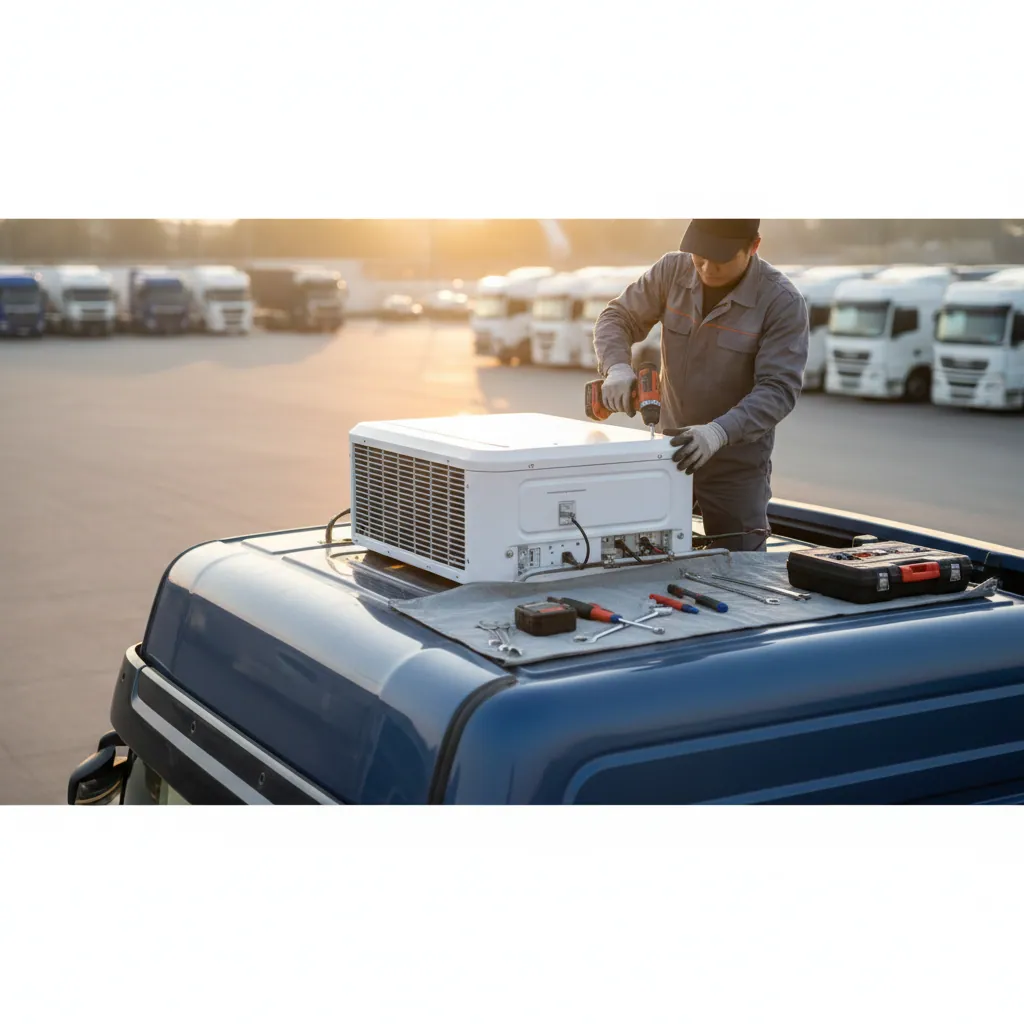
Total installed cost for a parking air conditioner in 2026 ranges from $899 on the low end (DIY, 12V rooftop, no electrical upgrade) to $4,200+ on the high end (pro install, dual-evaporator RV split, LiFePO4 bank + solar). Most truck drivers and RV owners land between $1,400 and $2,600 all-in. This guide breaks the number down so you can estimate your specific project in under 10 minutes.
What's Actually in the Installed Price
Installed cost = unit price + electrical upgrade + labor + ancillaries. Each line has a wide range, which is why quotes you see online ($800 to $2,400) feel unreliable — they collapse four independent variables into one range. Treat them separately and your own estimate becomes accurate within ±15%.
Line Item 1 — Unit Price by Type (2026)
| Unit type | BTU range | Typical price | Who it fits |
|---|---|---|---|
| 12V rooftop, compact | 6,000–9,000 | $699–$1,299 | Sleeper cabs, vans, small RVs |
| 24V rooftop, heavy-duty | 9,000–12,000 | $1,099–$1,799 | Class 8 trucks, box trucks |
| Rooftop heat+cool combo | 9,000 / 2.6 kW heat | $1,299–$1,999 | RV year-round, cold-climate fleets |
| Under-bunk / interior | 7,000–10,000 | $899–$1,499 | Aero-roof trucks, cargo vans |
| RV split system | 10,000–13,500 | $1,499–$2,499 | Class A/C motorhomes, fifth-wheels |
CoolDrivePro reference points: VS02-PRO top-mounted 9,000 BTU at $1,299, VX3000SP mini-split 12,000 BTU at $1,599, V-TH1 heating+cooling combo covers both ends of the thermal range. Competitor anchors: Dometic RTX 2000 around $2,100 street, Webasto Cool Top Trail 20 around $2,400.
Line Item 2 — Electrical Upgrade (Where Budgets Blow Up)
A 9,000 BTU DC parking AC draws 35–55 A at 12V under full load. A single Group 31 AGM battery (100 Ah usable ~50 Ah) runs it for 1–2 hours. Real-world overnight cooling needs 4–8× more capacity. The battery decision is the single biggest cost swing in the whole project.
Battery Options Ranked by $/usable-Wh
| Option | Upfront | Usable energy | Cycle life | $/kWh over life |
|---|---|---|---|---|
| Keep existing AGM (2× Group 31) | $0 | 1.2 kWh | 400 | $0.83 |
| Add 1× Group 31 AGM | $220 | +0.6 kWh | 400 | $0.92 |
| 100Ah LiFePO4 drop-in | $320 | 1.2 kWh | 3,000 | $0.09 |
| 200Ah LiFePO4 + BMS | $620 | 2.4 kWh | 3,000 | $0.086 |
| 300Ah LiFePO4 + smart BMS | $900 | 3.6 kWh | 5,000 | $0.05 |
LiFePO4 pays back in 12–18 months for anyone running the AC more than 3 nights a week. AGM only makes sense if you already own it and run the AC ≤2 hours per session.
Wiring, Fusing, Alternator
Budget these separately; they're not optional:
- Cable + lugs (2 AWG, 15 ft): $45–$80
- MRBF or ANL fuse block: $25–$60
- Battery monitor (Victron BMV-712 class): $180–$240
- DC-DC charger (30 A) if adding lithium to a stock alternator: $180–$320
- Solar controller (20–30 A MPPT): $140–$220 if integrating panels
Bare minimum electrical kit: $200. Full lithium + solar-ready setup: $900–$1,300. Skipping the battery monitor is the #1 regret reported by owners a year in — without it you can't diagnose whether the AC, the charger, or the battery is the bottleneck.
Line Item 3 — Labor by Install Type
| Install type | Shop hours | US labor rate | EU rate | Asia rate |
|---|---|---|---|---|
| Rooftop, existing roof vent cutout | 3–4 h | $285–$480 | €240–€400 | $90–$180 |
| Rooftop, new roof cut + seal | 5–7 h | $475–$840 | €400–€660 | $150–$280 |
| Under-bunk or cargo-area | 4–6 h | $380–$720 | €320–€560 | $120–$240 |
| RV split (condenser + evaporator + lineset) | 8–12 h | $760–$1,440 | €640–€1,120 | $240–$480 |
| Add battery bank + DC-DC + monitor | +3 h | +$285 | +€240 | +$90 |
Rates reflect 2026 Q2 averages: $95/hr US independent shop, $120/hr US dealer, €80/hr EU, $30/hr SE Asia. Dealers charge 25–40% more than independent installers for identical work. Mobile RV techs add $1.50–$2/mi travel.
Line Item 4 — Ancillaries That Aren't in Most Quotes
- Roof gasket + sealant (Dicor lap sealant + butyl tape): $35
- Mounting hardware kit (if not included): $45–$90
- Shroud / deflector for aero trucks: $120–$280
- Thermostat upgrade to Bluetooth controller: $60–$140
- Permit / inspection (rare, but some EU/AU jurisdictions require for roof modification on commercial vehicles): $0–$180
- Downtime cost if your vehicle is revenue-generating: 1–2 days × daily rate
Owner-operators routinely underestimate downtime cost. A truck earning $400/day that's parked 2 days for install = $800 in opportunity cost, which often exceeds the labor bill itself.
Four Real-World Tier Budgets
Tier 1 — DIY Budget Sleeper ($899–$1,350) 9,000 BTU 12V rooftop unit ($799) + reuse existing 2× AGM batteries ($0) + basic wiring kit ($95) + DIY install on existing roof opening (0 labor). Works if: you have tools, a garage, and an evening. Caveat: you'll likely add lithium within 12 months once runtime frustrates you.
Tier 2 — Pro Install, Stock Electrical ($1,450–$2,100) 9,000 BTU unit + independent shop install on new roof cut (4 h @ $95 = $380) + $120 ancillaries + no battery upgrade. Works if: you're a fleet adding AC to existing trucks with already-upgraded electrical, or a weekend RVer on shore power.
Tier 3 — Owner-Operator Sweet Spot ($2,100–$2,900) 9,000 BTU unit ($1,100) + 200Ah LiFePO4 + BMS ($620) + DC-DC charger ($240) + battery monitor ($200) + pro install 6 h ($570) + ancillaries ($150). This is the 70% case — real overnight runtime, pro workmanship, resale-friendly.
Tier 4 — Full Off-Grid RV ($3,400–$4,200) RV split 13,500 BTU ($2,299) + 300Ah LiFePO4 + smart BMS ($900) + 400W solar + MPPT ($520) + DC-DC ($240) + full electrical overhaul labor 10 h ($950) + ancillaries ($200). Works if: you boondock more than 30 nights/year, or your AC is non-negotiable.
Compare AC types before committing to a tier — the wrong unit kills any budget.
Regional Cost Differences (2026)
| Region | Unit markup vs MSRP | Labor index (US=1.0) | Typical Tier 3 all-in |
|---|---|---|---|
| US Midwest | 0% | 0.85 | $2,100 |
| US Northeast / California | +5% | 1.15 | $2,800 |
| Canada | +8% (FX) | 1.05 | $2,750 CAD |
| UK / Germany / France | +12% (VAT+duty) | 1.00 | €2,400 |
| Eastern Europe (PL/CZ/RO) | +8% | 0.45 | €1,450 |
| Australia | +18% (freight+duty) | 1.20 | AUD 3,800 |
| Middle East (UAE) | +10% | 0.60 | $2,000 |
| SE Asia / India | +5% | 0.30 | $1,400 |
| South Africa | +22% (duty+FX) | 0.50 | ZAR 42,000 |
Markets with highest installed cost aren't always the richest — Australia and South Africa pay premiums from import duty and freight, not labor. Buying direct from manufacturers like CoolDrivePro and shipping via consolidator to your local installer beats local reseller price by 15–30% in these markets.
DIY vs Professional — Decision Matrix
Go DIY if all five are true:
- You can read a wiring diagram and size cable to ampacity tables
- You have the tools (crimper, torque wrench, multimeter, heat gun)
- Your install requires no roof cutting (reusing existing vent hole)
- You're keeping stock electrical (no lithium swap)
- You accept voiding the unit warranty if the manufacturer requires pro install — check the fine print
Go pro if any are true: first-time install, roof cut required, battery system change, insurance/fleet policy mandates certified install, or vehicle is revenue-generating and downtime cost exceeds labor savings.
Common DIY failure modes we see in warranty claims: under-sized 8 AWG cable on a 50 A draw (fire risk), no dielectric grease on outdoor lugs (corrosion within 6 months), improper roof sealant (water ingress in year one). Our wiring guide covers the minimum-safe approach.
What Drives Installation Cost Higher Than Expected
Five causes account for 80% of budget overruns:
- Discovering the existing alternator can't charge the new lithium bank, forcing a DC-DC charger add-on mid-project (+$240–$400)
- Corroded stock battery cables requiring replacement once the new unit exposes the weakness (+$80–$150)
- Needing a custom shroud on aero trucks with sloped roofs (+$180)
- Refrigerant line extension on non-standard vehicle layouts (+$120/ft on split systems)
- Wood rot or rust in roof structure discovered during cutting, requiring reinforcement (+$150–$450)
Mitigation: ask the installer to quote a 2-hour pre-install inspection for $150–$200. Finding #5 before you commit is worth 10× the inspection fee.
Payback: When Does the Investment Clear?
For an owner-operator truck idling 8 hours/night × 250 nights/year at $3.80/gal diesel and 0.8 gal/hr idle consumption: $6,080/year in fuel burn. A $2,400 parking AC install pays back in 4.7 months of avoided idling, ignoring maintenance savings and anti-idling fines in 34 US states.
For a weekend RVer using the AC 25 nights/year on generator ($5–$8/hr fuel + maintenance): payback stretches to 5–8 years. The buy case here is comfort and campground noise compliance, not ROI. Run your own numbers before committing.
Choosing an Installer — What to Ask
Any shop worth hiring will answer these without hedging:
- How many parking AC units have you installed in the last 12 months? (Target: ≥20)
- What's your warranty on the install itself, separate from the unit warranty? (Target: 12 months parts + labor)
- Can you show me a photo of a previous install on a vehicle like mine?
- What cable gauge do you use for a 50 A run? (Correct answer: 4 AWG for up to 10 ft, 2 AWG beyond)
- Do you torque roof bolts to spec and document it? (Correct answer: yes, with torque wrench, 30–35 in-lbs typical)
- What sealant do you use and what's its service life? (Acceptable: Dicor self-leveling, 3M 5200; service life 3–5 years)
Red flags: no written quote, refusal to itemize parts vs labor, cash-only, pressure to upgrade to a unit they have in stock rather than what you selected.
FAQ
Is installation cheaper at a dealer or independent shop? Independent shops are 25–40% cheaper for identical quality work. Dealers make sense only if your vehicle is under warranty and dealer install is required to preserve it.
Can I finance the install? Most independent shops don't offer financing. Fleet operators use equipment leases (36 months, ~8% APR). Consumer RV dealers often bundle AC into the RV loan at delivery — this is the cheapest financing option but only works at point of purchase.
Does installing a parking AC void my vehicle warranty? Roof penetrations can void structural warranty if improperly sealed. Electrical modifications may void powertrain warranty if linked to a failure. Always check with your dealer first — some manufacturers offer pre-approved installers.
How long does installation take? Basic rooftop: 3–4 hours for experienced techs. RV split systems: 1–2 full days. Add 3–4 hours if upgrading the battery bank.
What's the #1 mistake buyers make? Under-sizing the battery bank to save $300 upfront, then spending $900 to fix it 6 months later when runtime is insufficient. Our calculator prevents this.