Parking Air Conditioner Buying Guide 2026: How to Pick the Right Unit (Without Wasting $1,500)
2026 parking AC buying guide: 7-step decision framework, BTU sizing table, spec thresholds, cost budgets by tier, and the 5 mistakes that turn a $1,500 AC into scrap. Read before you buy.
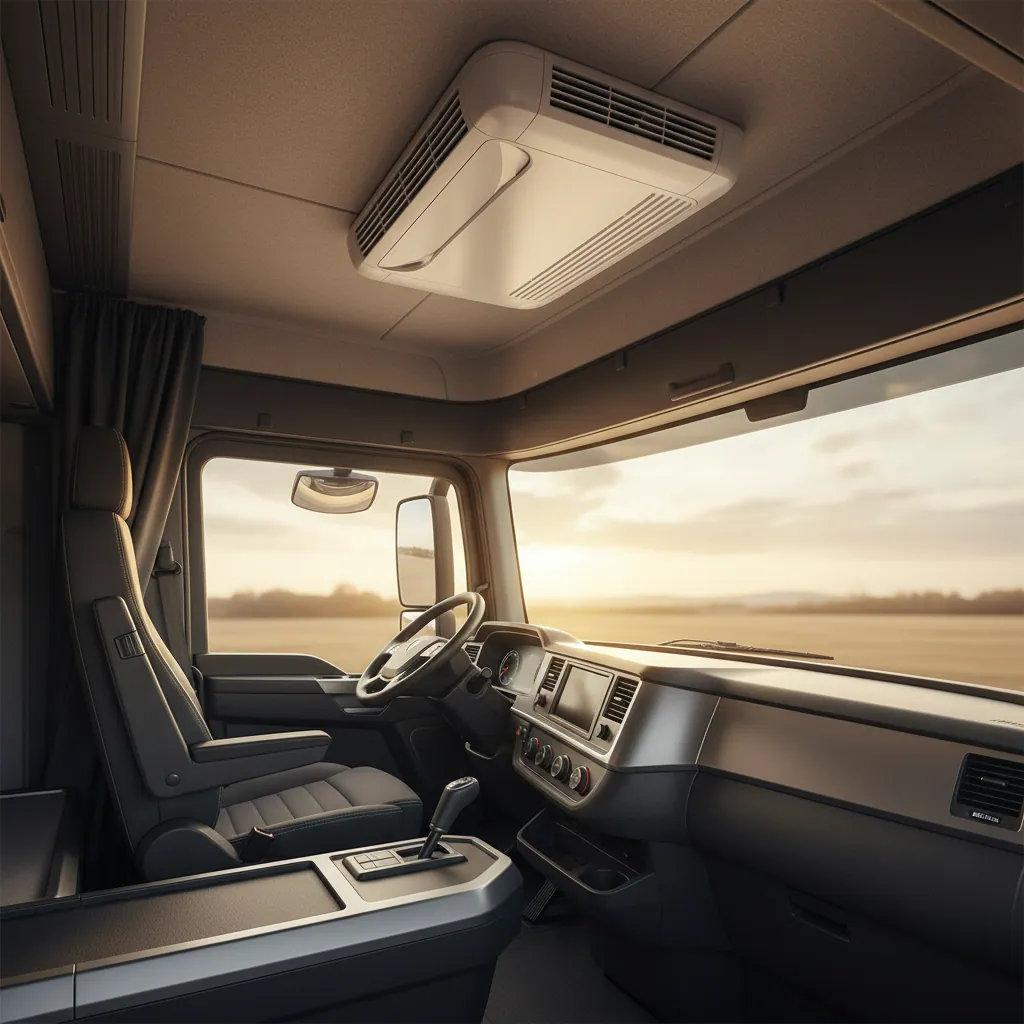
Most parking AC buying guides on the internet are written to sell one brand. This one is written to help you not waste $1,500. By the end, you'll know: (1) whether you even need a parking AC or just a 12V fan will do, (2) what BTU your cabin actually needs, (3) the five spec thresholds that separate a 10-year unit from a 3-year unit, (4) your total budget including battery and install, and (5) the five mistakes that brick the whole system. If you want the fast track, skip to the decision checklist at the end.
Step 1: Do You Actually Need a Parking AC?
A parking AC is the right answer when all four of these are true:
- You sleep or rest in the vehicle at least 2 nights per week in months when ambient exceeds 25°C
- Idling the engine is illegal, expensive (0.20 USD per hour fuel waste bothers you), or prohibited (stealth camping, company policy)
- You have or can add at least 150 Ah of LiFePO4 house battery
- You have a flat 14×14 inch roof area or rear-wall area for the unit
If any of these are false, consider alternatives first: high-CFM 12V fans (40–120 USD) handle airflow-only needs, reflective window shades plus a roof vent cut 15–20°F, and shore-power hookups make a fixed 120VAC unit far cheaper. Parking AC is a 2,300–4,200 USD all-in decision. It pays back fast when conditions 1–4 apply, and wastes money when they don't.
Step 2: Size the BTU (Don't Guess — Measure)
Under-sizing means the unit runs at 100% duty cycle, drains the battery, never reaches setpoint, and its lifespan is cut in half. Over-sizing causes short-cycling, a humid cabin, and higher capex. Get this right with the cabin-volume rule:
BTU needed = cabin volume (m³) × climate multiplier × insulation factor
| Climate (peak summer high) | Multiplier |
|---|---|
| Mild (<30°C) | 300 BTU/m³ |
| Moderate (30–35°C) | 400 BTU/m³ |
| Hot (35–40°C) | 500 BTU/m³ |
| Extreme (>40°C, desert) | 650 BTU/m³ |
Insulation factor: 1.0 for a typical RV or truck cabin, 1.2 for an uninsulated van shell, 0.85 for a well-insulated build (closed-cell foam plus thermal bridging addressed).
Worked examples: - Class 8 sleeper cab (2.2 × 1.8 × 2.0 m = 7.9 m³), US Southeast summer (35–40°C), stock insulation: 7.9 × 500 × 1.0 = 3,950 BTU minimum → buy 6,000–7,500 BTU (always 50% headroom) - Sprinter 144 high-roof (3.5 × 1.7 × 1.95 m = 11.6 m³), Arizona (>40°C), pro-insulated: 11.6 × 650 × 0.85 = 6,400 BTU → buy 8,000–9,000 - Class A RV main living area (9.0 × 2.4 × 2.0 m = 43 m³), Florida (35°C): 43 × 400 × 1.0 = 17,200 BTU → buy 24,000+ or run two zones
The headline rule: always buy 40–60% more BTU than the formula gives you. Real-world cabins have sun load, body heat, and appliance heat the formula doesn't capture.
Step 3: The 5 Spec Thresholds That Separate Good From Junk
Ignore everything marketing tells you. Check these five numbers on the datasheet before clicking buy:
| Spec | Minimum threshold | Why it matters |
|---|---|---|
| Compressor type | Dual-rotary or scroll | Single-rotary compressors fail at 4,000–6,000 runtime hours; dual-rotary last 12,000+ |
| COP (coefficient of performance) | 2.8 or higher | Below 2.8, every BTU costs too much battery. A 2.5 COP unit drains 12% more battery than a 3.0 COP unit at the same output |
| Noise at 1 m, low speed | 45 dB or quieter | Above 48 dB you can't sleep through it — defeats the whole purpose |
| Warranty (compressor) | 24+ months, with in-region parts | Longer is better but verify parts actually stock in your country. A 5-year warranty with a 12-week part lead time is effectively a 12-week warranty |
| Refrigerant | R32 (or R454B in newest units) | R410A is being phased out globally by 2027; avoid it in any new purchase |
If a unit fails any of these, walk away regardless of price. A 699 USD Amazon special that fails the compressor, COP, or warranty test is more expensive than a 1,300 USD quality unit after the 3-year replacement cycle kicks in.
Step 4: Rooftop vs Mini-Split vs Portable
| Form factor | Best for | Pros | Cons | Typical price |
|---|---|---|---|---|
| Rooftop | Trucks, RVs, vans with flat roof | Simple install, all-in-one, even airflow, ~800 USD cheaper to install than mini-split | Cuts into roof space, adds 10–20 cm height, slight aero impact | 1,100–1,800 USD unit |
| Mini-split | Large cabins, aesthetic builds, over 10,000 BTU | Quieter interior unit, higher BTU capacity, no roof penetration if rear-wall mount | Refrigerant lineset work requires pro install (plus 600–1,200 USD labor), dual-unit footprint | 1,400–2,200 USD unit |
| Portable | Occasional use, renters, shore-power setups | No installation, shore power compatible | Not truly a DC parking AC — most need 120VAC, blocks a window, lower efficiency | 400–900 USD unit |
For 95% of truck, RV, and van buyers, rooftop is the right answer. Choose mini-split if BTU requirement exceeds 10,000 or you specifically need no roof penetration. Portable units are usually a mistake for true parking use — they're designed for home or office. Full comparison of mini-split vs rooftop.
Step 5: 12V or 24V — Match Your Vehicle
Default rule: match your vehicle's native electrical voltage. 12V for pickups, vans, most RVs, and US/Canadian Class 8 trucks. 24V for European heavy trucks, buses, and some custom off-grid builds. Mismatch costs 7–10% efficiency and 200–300 USD in converter hardware, and adds a failure point.
One exception worth the converter cost: if you need the CoolDrivePro V-TH1 heat-and-cool combo on a 12V truck, the converter penalty (about 250 USD plus 8% loss) is still 600+ USD cheaper than installing a separate diesel bunk heater. Otherwise, native-voltage match wins. Full 12V vs 24V decision tree.
Step 6: Budget the Full Stack (Not Just the Unit)
The #1 buyer mistake: focusing on unit price and blowing the battery and install budget. Here's what the full stack actually costs in 2026:
| Component | Tier 1 Budget | Tier 2 Standard | Tier 3 Premium | Tier 4 Pro Fleet |
|---|---|---|---|---|
| AC unit (BTU) | 899 USD (6,000) | 1,299 USD (9,000) | 1,799 USD (9,000 + heat) | 2,100 USD (12,000) |
| LiFePO4 battery | 450 USD (100Ah) | 640 USD (200Ah) | 920 USD (300Ah) | 1,280 USD (400Ah) |
| Cable + fuses + lugs | 80 USD | 120 USD | 160 USD | 220 USD |
| Installation labor | 350 USD (DIY with help) | 700 USD | 1,050 USD | 1,400 USD |
| Optional: solar 200W+ | — | 320 USD | 480 USD | 640 USD |
| Optional: inverter 1000W | — | — | 280 USD | 380 USD |
| Total all-in | ~1,779 USD | ~3,079 USD | ~4,689 USD | ~6,020 USD |
Most buyers land in Tier 2 (3,079 USD). Tier 1 is real only if you already have battery capacity. Tier 4 is for fleet deployments with standardization requirements. Full installation cost breakdown.
Step 7: Pick By Use Case
Class 7–8 semi truck (long-haul owner-operator) → CoolDrivePro VS02-PRO (9,000 BTU, 42 dB, dual-rotary) + 200 Ah LiFePO4 + pro install = about 2,900 USD all-in, 3-year payback from fuel savings alone.
Sprinter / ProMaster / Transit van build → CoolDrivePro Nano-Max (10,000 BTU, 40 dB, lightest at 16 kg) + 200 Ah LiFePO4 + 300W solar = about 3,200 USD all-in for full off-grid capability.
Class A/B/C RV (leisure use) → Dometic RTX 2000 if polish and dealer network matter, or CoolDrivePro VX3000SP (12,000 BTU mini-split) for larger cabins. Budget 3,500–4,500 USD all-in.
Year-round / cold-region operator → CoolDrivePro V-TH1 (9,000 BTU cool + 2.6 kW heat pump) — eliminates the need for a separate diesel bunk heater. 3,800–4,200 USD all-in.
European fleet manager → Webasto Cool Top Trail 20 for service-network continuity, or CoolDrivePro if building a new spec with better price-to-performance. Budget 3,200–4,000 EUR all-in per truck.
Full 9-unit comparison: Best Parking AC 2026.
The 5 Mistakes That Brick the System
After years of warranty claims and forum post-mortems, these are the patterns:
1. Under-sized battery bank (most common, about 40% of disappointment cases) Runs for 90 minutes then quits. Fix: size battery for peak draw × 1.5 safety × runtime target, minimum 200 Ah LiFePO4 for a 9,000 BTU unit.
2. Wrong cable gauge Voltage sag at startup trips low-voltage cutoff. Use 2 AWG for 12V systems with runs under 15 ft, 4 AWG for 24V. Don't cheap out here — cable cost is 50 USD.
3. Skipping the MRBF fuse One loose connection at 50+ A becomes a fire. An MRBF fuse block at the battery is non-negotiable. 50 USD of hardware that prevents a 200k USD vehicle loss.
4. Buying single-rotary compressor units Price-shopped the 699 USD Amazon unit, got 4,000 hours of service, replaced twice — paid more than one quality unit. Check compressor type before buying.
5. Ignoring airflow path inside the cabin Installed the rooftop unit but blocked the outlet with a curtain or partition. Evaporator ices up, compressor shuts off. Unit isn't the problem — install is.
FAQ
Can I install this myself? Rooftop: yes, if you're comfortable cutting a 14×14 inch hole in your roof and doing basic 12V electrical. Mini-split: no — refrigerant work requires a vacuum pump and EPA 608 certification in the US. DIY saves 400–700 USD.
How long until it pays back? Fleet math: 10 idle hours × 300 nights × 0.8 gal/hr × 4 USD/gal = 9,600 USD/yr fuel savings. A 3,000 USD stack pays back in 4 months on a daily-use truck. Leisure RV math differs — payback is in comfort, not dollars.
What about solar? Do I need it? Depends on usage. Daily drivers with alternator charging typically don't need solar. Boondockers and van-dwellers need at least 200W. Stationary vehicles (stored RVs) need 400W or a shore tender.
Does ambient humidity affect sizing? Yes — humid climates need about 15% more BTU because latent heat removal eats capacity. Florida, Gulf Coast, and SE Asia buyers should use the next climate tier up in Step 2.
Is R32 refrigerant safe? R32 is mildly flammable (A2L classification), but in sealed parking AC systems with under 150g charge, it's within all applicable safety standards. Don't DIY refrigerant service on R32 without training.
What if I plan to sell the vehicle in 3 years? Rooftop units typically transfer with the vehicle and add 800–1,500 USD to resale. Keep the warranty documentation. Branded premium (Dometic) transfers better than generic; CoolDrivePro sits in between.
Heat pump or separate heater? A heat pump (like the V-TH1) works down to about -15°C depending on model. Below that, or in sub-zero nightly lows, pair the heat pump with a small diesel backup. For most North American and European climates, the heat pump alone is sufficient year-round.
## Frequently Asked Questions
What size parking AC do I need for a Class 8 sleeper cab?
A 90 cu ft sleeper needs 5,000–8,000 BTU/hr. The CoolDrivePro V-TH1 (10,000 BTU peak, 6,500 BTU sustained) handles cabs up to 110 cu ft in 95°F ambient. For RV bedrooms, jump to 12,000 BTU.
Diesel-fired or battery-powered — which is better in 2026?
Battery-powered wins on emissions, noise (sub-45 dBA), and idle-law compliance. Diesel-fired has lower upfront cost but burns 0.05–0.1 gal/hr at $3.85–$4.20/gal. See our parking AC vs APU comparison for total cost-of-ownership math.
Which brand has the best warranty in 2026?
CoolDrivePro offers 3 years on the unit and 5 years on LiFePO4 batteries. Dometic RTX is 2 years; Webasto Cool Top is 2 years; RigMaster is 1 year on the compressor. Always read fine print on labor coverage.
Can I run a parking AC purely on solar?
Yes — but you need 600–800W of rooftop solar plus 200Ah of LiFePO4 to sustain 8 hours of cooling overnight. Most owners pair solar with shore power or alternator charging for redundancy.
What certifications should I look for?
CE, FCC, RoHS at minimum. For California, CARB compliance matters. For EU markets, EN 14511 efficiency rating. Avoid no-name imports without UL/ETL on the inverter.
Decision Checklist
Copy this and fill in your answers before buying:
- [ ] Cabin volume measured (L × W × H in meters): _____
- [ ] Climate tier (mild / moderate / hot / extreme): _____
- [ ] BTU required (volume × multiplier × insulation factor): _____
- [ ] BTU to buy (required × 1.5): _____
- [ ] Vehicle native voltage (12V or 24V): _____
- [ ] Current battery capacity (Ah and chemistry): _____
- [ ] Battery upgrade needed? (target 200+ Ah LiFePO4): _____
- [ ] Install: DIY or pro? _____
- [ ] Form factor: rooftop / mini-split / portable: _____
- [ ] Budget tier (1 / 2 / 3 / 4): _____
- [ ] All-in budget confirmed: $_____
- [ ] Specific unit chosen (check all 5 spec thresholds): _____
- [ ] Warranty parts availability in my region: yes / no
When every line is filled, buy. If any line is uncertain, stop and resolve it — uncertainty is where the 1,500 USD mistakes live.
Ready? Start with Best Parking AC 2026 for model-by-model comparison, then Installation Cost Breakdown for the labor math, then contact CoolDrivePro for a factory-direct quote if our units match your use case. For deeper detail, see our LiFePO4 battery sizing for parking AC.